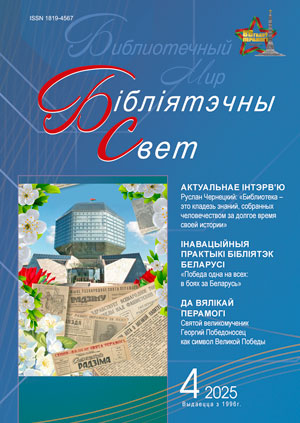
The publication publishes original articles containing the results of research in pedagogical (library science, bibliographic science and book science), philological sciences and art history.
The journal is aimed at the teaching staff, researchers, applicants for academic degrees and practitioners.
In addition, the publication reflects the best practices of libraries in the Republic of Belarus and abroad, which will allow presenting scientific and practical (popular) materials to a wider audience, strengthening scientific ties and sharing research, work experience and problematic issues with the professional community.
Current issue
 Open Access
 Subscription Access
Congratulations
Інавацыйныя практыкі бібліятэк Беларусі
Краязнаўства
News of BLA
Conferences, seminars
Anniversaries
Бібліятэказнаўства
The article is devoted to the analysis of the thematic collection of the INION RAN Fundamental Library dedicated to the Republic of Belarus. The structure of the fund, which has 545 storage units, is considered, and key thematic clusters are identified: linguistics and philology, history and culture, literary studies, economics and law. The author shows how the systematic collection of scientific publications reflects the strategic partnership between the Russian Federation and the Republic of Belarus and serves not only as an information resource, but also as a tool for identifying priority areas for further cooperation with scientific and educational organizations in Belarus. Based on the analysis, the main producers of knowledge are identified and specific proposals for the development of interinstitutional cooperation are formulated.
The results of an expert survey of libraries at higher education institutions in the Republic of Belarus on the development of students' research competencies are presented. Current trends in the work of the surveyed libraries in this area are identified. The survey results confirmed the importance of developing research competencies at library sites, the interest in enhancing students' research potential, and the existing need for training competent library specialists and developing methodological materials for their effective work in this area. An analysis of the survey results made it possible to identify internal and external factors in the activities of libraries of higher education institutions in developing students' research competencies.
Агляды і рэцэнзіі
A review of the monograph «Инноватика как теория управления современной библиотекой» «Innovation as a Theory of Modern Library Management» is presented. The author of this scientific publication is Elena Nikolaevna Guseva, PhD in Pedagogical Sciences, Head of the Department of Information and Analytical Activities at Moscow State Linguistic University, Director of the Department of Scientific and Educational Activities at the Russian State Library, and Actual State Counselor of the Russian Federation, 3rd Class. The study is the result of the author's research on this topic.
Філалогія
In the article, as part of the dialogue between son and father, a complex of ideas that developed around the concept of «Russian European» is discussed. In literature, the general interpretation of Verzilov’s views often turns into a concept of «Russian idea», within which the Europeancentric position of the hero turns out not to be the sign, but the meaning that the writer operates. This substitution of phenomena, passing into their identification, is actualized by the theme of generations to which the writer’s novel refers. However, it is precisely those forms, the «language of culture» chosen by F.M. Dostoevsky to embody the dialogue between son and father, that point to the unliveable, «inanimate» nature of the concepts which Versylov uses in his conversations with Arkady. The analysis of these forms, reflecting the very essence of views, allows to open the contained in them apophatic impulse, which is the soughtafter meaning of the dialogues of heroes, explaining the final formula for defining the «Russian European» in his relation to the «earthly» writer: «only half of the former Versylova». The activity in the consciousness of the hero of «tenword» reveals in him a certain historical type of «borderline», rising to the essential problems of the relationship between Russian and European cultures.
The article examines the culture of speech and such a component as richness/diversity. It is noted that this communicative quality has a system of means of realization and is actualized at all language levels (phoneticorthopedic, lexical, word formative, phraseological, syntactic). However, it is the lexical level that represents the largest number of units that help to most fully, accurately, and appropriately construct an expression taking into account the content of the text and the speech situation. Such lexical units as synonyms, antonyms, homonyms, paronyms, and neologisms always allow the realization of the aforementioned communicative quality. Various types of stable expressions diversify speech: used with an occasional or usual function, phraseological units and proverbs decorate the content with the charm of the vernacular and convey a variety of semantic nuances and emotional subtleties of the narrator's thoughts and feelings. In turn, it is noted that at the syntactic level, the richness of speech is realized through a large number of synonymous and non synonymous constructions, which allow avoiding uniformity and stereotyped presentation of the material. The richness of a person's speech allows avoiding a number of stylistic errors. The article highlights the ways and means of enriching a person's lexicon.
Мастацтвазнаўства
This material is the result of a study on the development of professional fine arts within the system of the artistic culture of the Republic of Belarus. The scientific and theoretical significance of the material is determined by the theoretical and methodological model for analyzing the artistic process developed by the author, which combines elements of historical cultural, phenomenological, and hermeneutic approaches. This model allows for the consideration of artworks not only as visual facts but also as events of spiritual experience reflecting the profound meanings of the era, as well as collective and individual artistic consciousness. In each period of the development of Belarusian fine arts, a continuity is traced, based on an understanding of the artistic value of creative heritage, traditions, and the national mentality. At the current stage of development, the fine arts of Belarus, while maintaining their commitment to academic traditions, are enriched by means of artistic expression of a formalexperimental nature.